
In March 1995, at the Geneva Motor Show, Ferrari presented the car that would celebrate its 50th anniversary: the Ferrari F50. It was not meant to be the fastest Ferrari on paper. It was meant to be the closest thing to a Formula 1 car that a customer could legally drive on the road. Thirty years later, the F50 is one of the rarest and most sought-after Ferraris in the world.
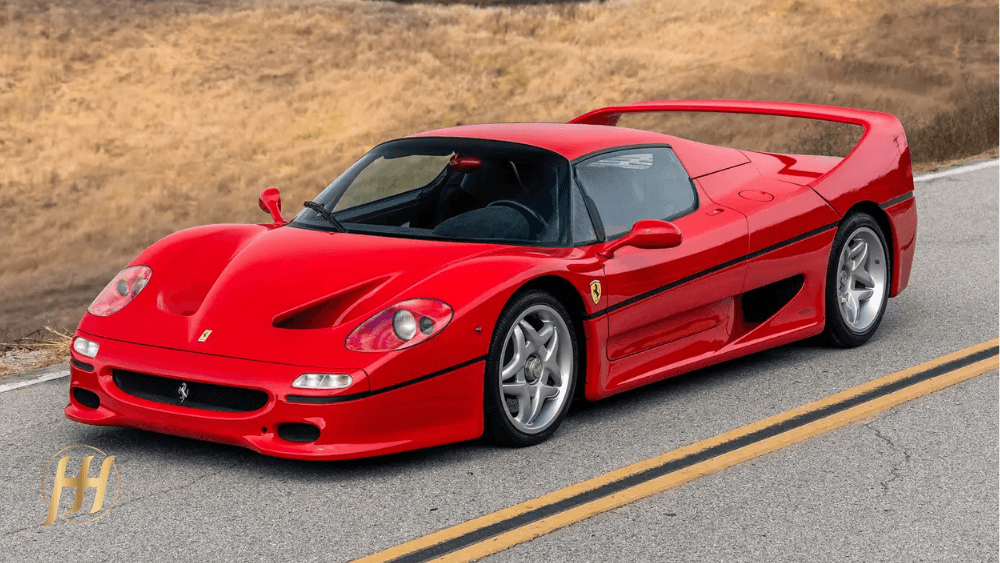
Why Ferrari built only 349 F50s
Enzo Ferrari used to say that the company should always build one car less than the market demands. For the F50, Ferrari estimated demand at around 350 cars, so production was fixed at 349 units, built between 1995 and 1997. Buyers were selected by the factory, and many were existing Ferrari collectors.
That decision is the main reason the F50 is so valuable today. Its predecessor, the F40, was built in more than 1,300 examples. The F50 is roughly four times rarer.
A Formula 1 engine for the road
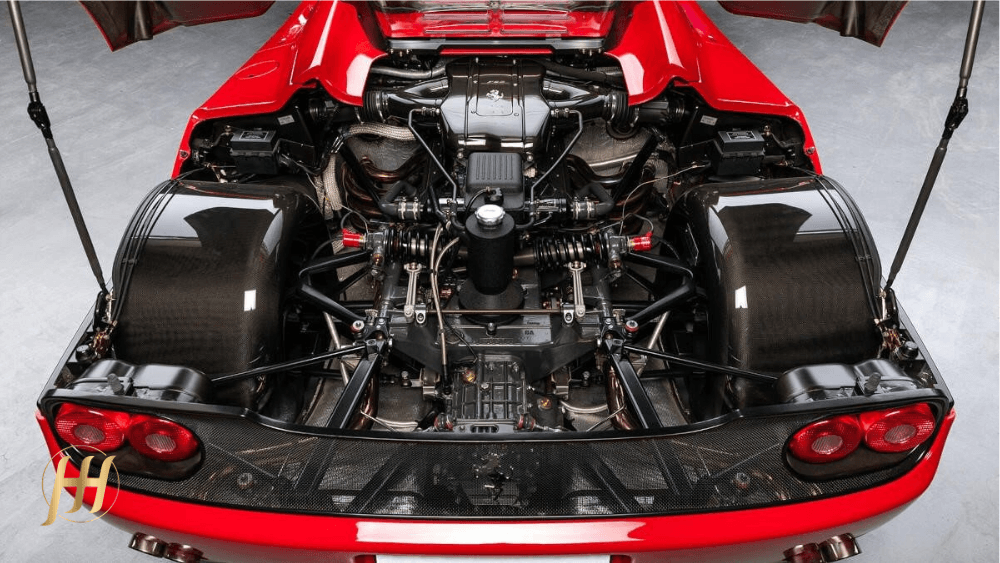
The heart of the F50 is a naturally aspirated 4.7-litre V12 derived from the 3.5-litre engine of the Ferrari 641, the car that raced in the 1990 Formula 1 season. Ferrari enlarged the engine for road use but kept its racing architecture: a 65-degree V12 with five valves per cylinder, 60 valves in total.
The result is 520 CV at 8,500 rpm and 471 Nm of torque. There is no turbocharger and no hybrid system. Power arrives in a straight line all the way to the top of the rev range, with a sound that is much closer to a 1990s Grand Prix car than to a modern supercar.
Carbon-fibre chassis and racing suspension
The F50 uses a carbon-fibre monocoque, a technology taken directly from Formula 1. The V12 is bolted straight to the back of the tub and works as a stressed member of the chassis, carrying the gearbox and the rear suspension. There is no subframe in between.
The suspension is also race-inspired, with inboard pushrod layout and electronically controlled dampers. Ferrari kept the driving experience pure: a six-speed manual gearbox with an open metal gate, no ABS and no power steering. The F50 asks for an experienced driver.
Ferrari F50 specifications
- Production: 349 units, 1995–1997
- Engine: 4,698 cc naturally aspirated V12, 65°, 60 valves
- Power: 520 CV at 8,500 rpm
- Torque: 471 Nm at 6,500 rpm
- Gearbox: 6-speed manual, rear-wheel drive
- 0–100 km/h: about 3.8 seconds
- Top speed: 325 km/h
- Dry weight: about 1,230 kg
- Chassis: carbon-fibre monocoque, engine as a structural element
- Design: Pininfarina
Berlinetta or barchetta: the removable roof
Every F50 can be driven in two ways. With the hardtop fitted, it is a closed berlinetta. With the roof removed, it becomes an open barchetta, the way Ferrari originally imagined it. The large rear wing, the twin front air intakes and the clean lines by Pininfarina all come from aerodynamic work, not decoration.
F50 GT: the racing car that never raced
Ferrari also developed a competition version, the F50 GT, to race in the new GT championships of the mid-1990s. Only three cars were built before the programme was cancelled in 1996. They never took part in an official race, which makes them some of the most mysterious Ferraris ever made.
F40, F50 and Enzo: the F50’s place in Ferrari history
The F50 sits between two legends. The F40 of 1987 was raw, turbocharged and built in large numbers. The Enzo of 2002 brought electronics, a paddle-shift gearbox and 399 units. The F50 is the only one of the three with a V12 taken directly from Formula 1 and the possibility to drive with the roof off. For many collectors, it is the purest of Ferrari’s flagship cars.
Why the F50 is so collectible today
- Rarity: 349 cars worldwide, and fewer still with low mileage and full history.
- Technology: a real Formula 1-derived engine and a carbon chassis in a road car.
- Analogue driving: manual gearbox and no driver aids, something modern hypercars no longer offer.
- Heritage: the car built for Ferrari’s 50th anniversary.
Values today are well into seven figures, and well-documented cars with low mileage are the most wanted.
Ferrari F50 at Hinsei Hanta
A 1995 Ferrari F50 with 3,800 km is currently in our showroom. See the photos and details on the Ferrari F50 page, explore more Ferrari models or browse the full inventory. Looking for a specific car? Our vehicle sourcing service searches Europe and the rest of the world for you.
Frequently asked questions
How many Ferrari F50s were made?
Ferrari built 349 F50s between 1995 and 1997, one car less than the estimated demand.
Does the Ferrari F50 have a Formula 1 engine?
Its 4.7-litre V12 is derived from the 3.5-litre engine of the 1990 Ferrari 641 Formula 1 car, enlarged and adapted for road use.
How fast is the Ferrari F50?
The F50 reaches about 325 km/h and accelerates from 0 to 100 km/h in about 3.8 seconds.
Is the Ferrari F50 a convertible?
Yes. It has a removable hardtop, so it can be driven as a closed berlinetta or as an open barchetta.